
A good quiff sharpens an ordinary haircut without looking overly styled. But the photo you like might depend on thicker hair or ten minutes with a blow-dryer. Finding a quiff that works with your natural hair makes styling much easier. This guide explains how to choose one, what to ask your barber, and how to keep it looking good at home.
I’ve also noticed that most men pick a quiff that’s too tall for their hair type so this guide starts with what actually works for different textures.
My advice is to pick a quiff that suits your usual morning, not just your best hair day.
What Makes Quiff Hairstyles Different?
A quiff lifts the hair above the forehead, upward, backward, or slightly sideways. The rest of the top supports that front lift. Most quiff haircuts have neatly trimmed sides that blend gradually into the longer hair on top.
At first glance, a quiff and a pompadour can look quite similar. A pompadour usually has a more continuous, sculpted sweep across the top, while a quiff can be shorter, looser, and visibly textured. Unlike a fringe that hangs across your forehead, a quiff gives the front hair an upward lift.
Its strength is flexibility: neat for work, undone for weekends, or taller for an occasion. The trade-off is styling: if your hair naturally falls forward, a taller quiff will take more effort to hold.
How to Choose the Right Quiff for Your Hair
Start with texture, face shape, and trim frequency. No product completely changes your growth pattern.
- Fine or thin-looking hair: A shorter quiff with a little texture usually works better for finer strands. Keep around 2–3 inches at the front and avoid thick styling products that weigh your hair down.
- Thick, straight hair: A classic or tapered quiff gives you room to shape the front. Ask for controlled weight removal rather than aggressive thinning everywhere.
- Wavy hair: Work with the bend. A wavy quiff usually needs less precise combing and a flexible, lightweight product.
- Curly or coily hair: Let your natural curls create the shape and character of your quiff instead of trying to straighten them. A curly quiff is more about directing the front upward than forcing it into a straight wave.
- Hair that grows forward or has a cowlick: A side-swept or shorter quiff may cooperate better than a tall, straight-back version.
- Receding hairline: Keep the front soft and irregular if you prefer not to emphasize the temples. Avoid assuming that a taller style automatically hides hair loss.
Your face shape can help you choose a flattering quiff, but it shouldn’t limit your options. Extra height can visually lengthen a round face; if your face is already long, moderate lift and fuller sides may create better balance.
My take: If you cannot describe how you normally dry and style your hair, start with a lower quiff. You can always leave more length at your next appointment.
10 Quiff Hairstyles Worth Trying
1. Classic Quiff
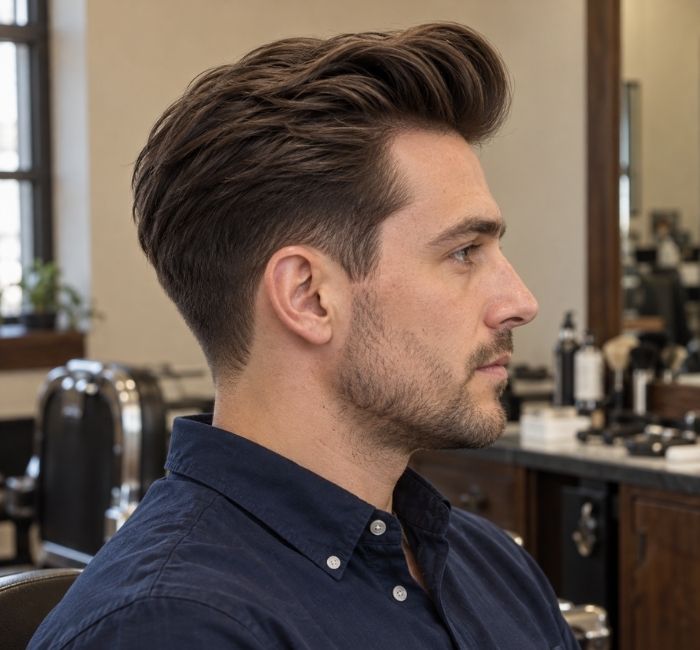
The classic quiff lifts the front into a smooth, rounded wave. Shorter sides blend into the top for neat movement rather than a rigid wall of hair.
Best for: Medium to thick straight hair, especially if you prefer a polished everyday haircut.
Watch out for: Letting the front grow so heavy that it collapses.
Ask for about 3–4 inches at the fringe, tapering slightly shorter toward the crown, with scissor-cut or softly clipped sides. Blow-dry the front upward and back with a vent brush, then use a small amount of medium-hold paste.
Check the side profile: the lift should curve naturally, not point straight up.
2. Short Quiff

A short quiff creates visible lift without much length. The front is about 1.5–2.5 inches, with tidy sides for minimal fuss.
Best for: Busy routines, finer hair, and men growing out a short crop.
Watch out for: Cutting the front so short that it has nothing to fold back.
Ask your barber to leave the hair at the front a little longer while gradually reducing the length toward the back of your head. At home, push damp hair upward with your fingers while drying on low heat, then pinch in a little matte paste.
In my experience, this forgiving starter cut often resets with your fingers when it loses volume.
3. Textured Quiff
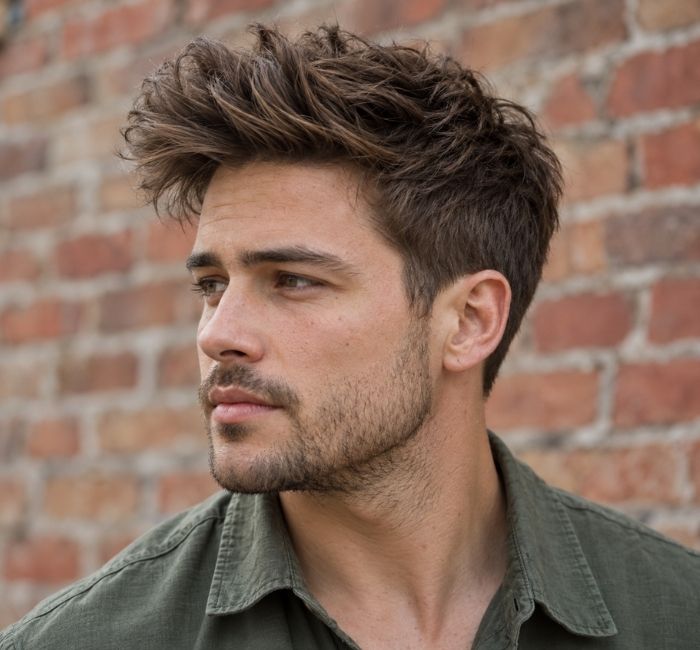
A textured quiff separates the front into pieces rather than one smooth sweep. Uneven movement creates a casual but deliberate finish.
Best for: Thick straight or slightly wavy hair.
Watch out for: Over-thinning the ends, which can make the top look wispy.
Ask for around 2.5–4 inches at the front and point-cut texture that preserves enough density. Dry the roots upward, rub a pea-sized amount of matte clay between your hands, and separate a few pieces with your fingertips.
My take: Stop adjusting it once the shape is there. Excessive touching can flatten the texture.
4. Low-Taper Quiff
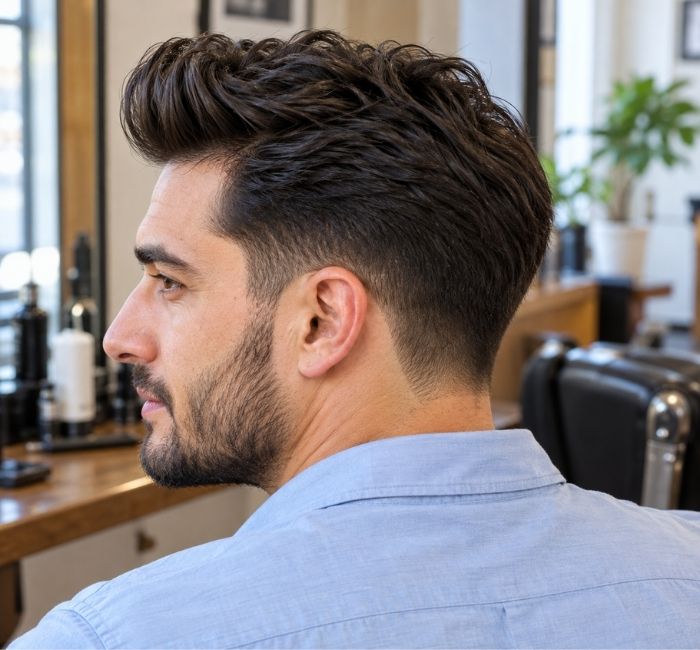
The low-taper quiff combines front lift with a gradual taper around the ears and neckline. Unlike a high fade, this haircut keeps the sides a little fuller, giving the overall style a softer appearance.
Best for: Office settings, first-time quiff wearers, and people who want a soft grow-out.
Watch out for: Asking for sides so bulky that the top loses definition.
Tell the barber you want a low taper that stays low around the temples, with about 2.5–4 inches available at the front. For a relaxed look, work a small amount of styling cream through your hair. If you need extra control, choose a matte paste instead.
Try this before the skin fades if you dislike frequent maintenance; it grows out softly.
5. Skin-Fade Quiff
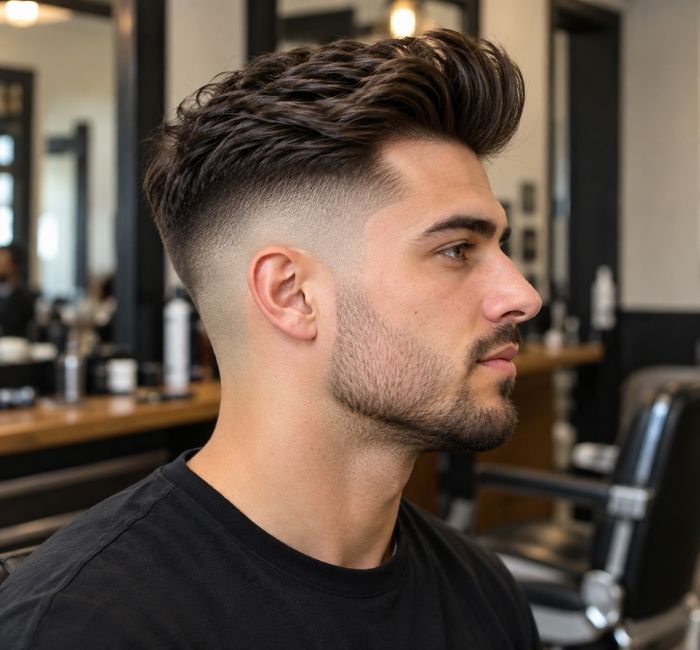
A skin-fade quiff contrasts near-bare sides with a longer top. Low, mid, or high fades create different degrees of contrast.
Best for: Men who enjoy crisp edges and regular barber visits.
Watch out for: A fade placed too high for your head shape or personal taste.
Bring a side-view reference and specify where the fade should start. Keep roughly 2.5–4 inches at the front, then blow-dry up and back and finish with controlled, small amounts of product.
The crisp fade grows out quickly, so expect more touch-ups than with a scissor taper.
6. Side-Swept Quiff
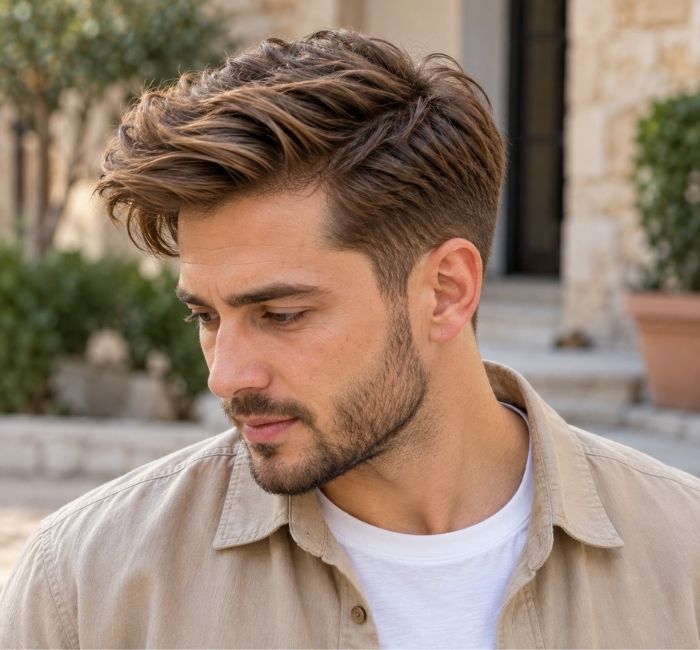
A side-swept quiff lifts diagonally rather than straight back. It can look relaxed or refined, and works well with a natural part.
Best for: Straight or wavy hair with a noticeable growth direction.
Watch out for: Fighting a cowlick so hard that the hair springs back later.
Ask the barber to leave 3–4 inches at the front and identify the direction your hair wants to travel. Aim the blow-dryer from the roots toward that side and guide the top with a brush or your fingers.
A little asymmetry helps; follow your natural part instead of forcing a centered shape.
Practical tip: Take a reference photo from both sides, since a sweep that looks great from one angle may sit differently from the other.
7. Wavy Quiff
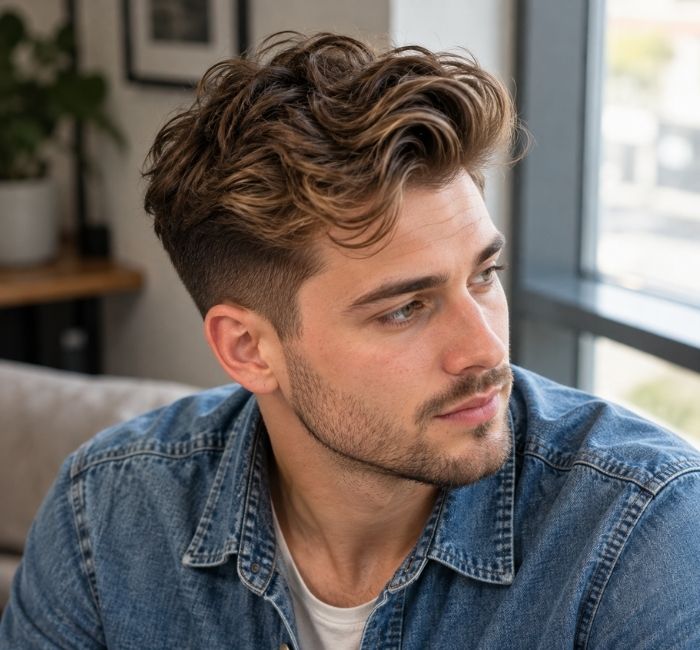
A wavy quiff lets bends create movement and softness at the front. Natural separation gives fullness without excessive height.
Best for: Naturally wavy hair of medium density.
Watch out for: Too much brushing once the hair is dry, which can disturb the waves.
Ask your barber to leave approximately 3–5 inches at the front so your waves have room to form naturally, with gentle layering to improve the shape. Scrunch a small amount of styling cream through damp hair, direct the roots gently upward, and let the lengths keep their pattern.
In my experience, guiding the waves rather than flattening them gives a more natural result. Let each morning’s pattern shape the finished style.
8. Curly Quiff
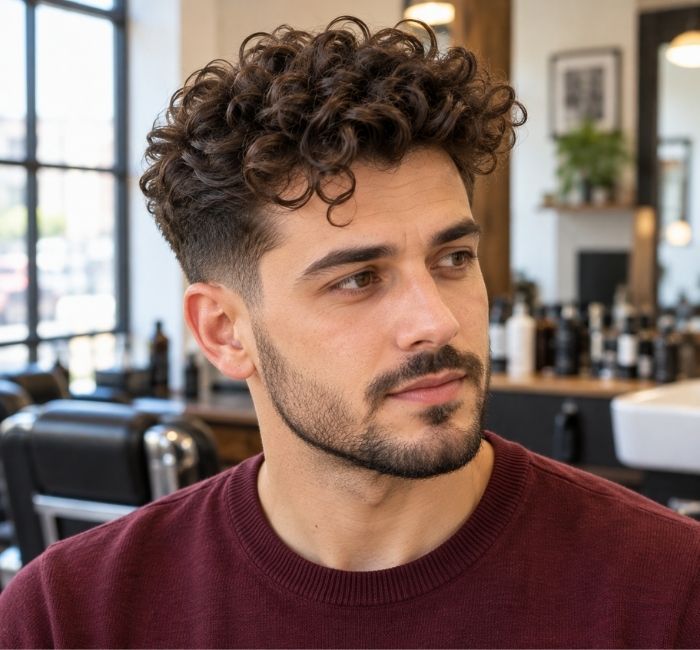
A curly quiff lifts front curls while preserving their pattern. Its outline can be rounded, and a severe fade is optional.
Best for: Defined curls or coils with enough length to show their natural shape.
Watch out for: Asking for a straight-hair reference that ignores shrinkage.
Have your stylist assess the curls in their natural state and discuss how short they appear after drying. Apply a curl-friendly leave-in or cream to damp hair, gently arrange the front, and dry with minimal disturbance.
My take: A curly quiff should look like your curls, only better positioned. Uniform height matters less than preserving the curl pattern.
9. Long Quiff

A long quiff creates a flowing front sweep with plenty of movement. Extra length gives styling options but adds weight.
Best for: Medium to thick hair and people comfortable spending time styling.
Watch out for: Heavy products and an overgrown crown dragging the front down.
Discuss keeping roughly 4–6 inches at the front, with the top shaped progressively shorter toward the crown. Apply heat protectant as directed, use controlled low or medium heat at the roots, then finish with a light hold product before adding anything heavier.
Build lift while drying; adding handfuls of wax afterward creates weight, not volume.
10. Fine-Hair Quiff
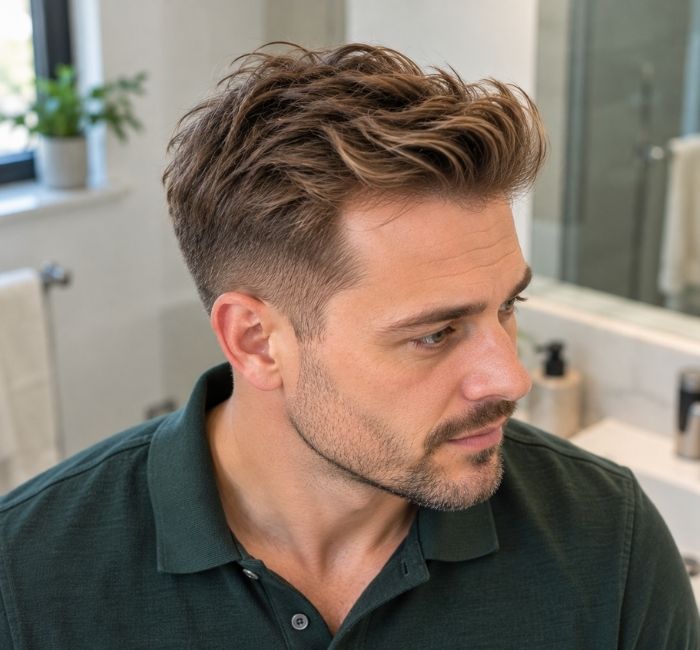
With fine hair, a modest quiff often looks better than a tall one because gentle volume at the roots creates lift without making the front appear too heavy. A slightly irregular outline adds dimension.
Best for: Fine hair that becomes limp under heavy products.
Watch out for: Excessive thinning or strong, sticky gel that separates hair into visible gaps.
Ask your barber to retain density, keep the front at about 2–3 inches, and avoid removing too much weight through the top. Use a small amount of lightweight volumizing product near the roots, dry gently upward, and add very little finishing paste.
A smaller quiff that holds naturally beats an unrealistic photo.
Practical tip: Test the style after an ordinary wash, not only on the day your barber finishes it; that shows how much lift your hair gives you without salon help.
Quick Comparison: Which Quiff Fits Your Routine?
| Quiff style | Front length (approx.) | Sides | Styling time* | Ideal starting point |
| Classic | 3–4 in | Soft taper | 5–8 min | Medium/thick straight hair |
| Short | 1.5–2.5 in | Short blend | 2–4 min | Low-maintenance mornings |
| Textured | 2.5–4 in | Taper or fade | 3–6 min | Thick hair |
| Low taper | 2.5–4 in | Low taper | 3–6 min | Subtle, versatile look |
| Skin fade | 2.5–4 in | Skin fade | 4–7 min | Sharp contrast |
| Side-swept | 3–4 in | Taper | 4–7 min | Natural side growth |
| Wavy | 3–5 in | Soft blend | 3–6 min | Loose waves |
| Curly | Varies with shrinkage | Taper or fade | 4–8 min | Natural curls |
| Long | 4–6 in | Blended | 7–12 min | Fuller hair, more time |
| Fine-hair | 2–3 in | Soft blend | 3–5 min | Lightweight volume |
Times are rough at-home estimates, not promises. They depend on hair density, drying method, and experience. Lengths are starting points to discuss with your barber, not fixed rules.
What to Discuss Before Your Barber Appointment
Bring front and side-view photos, and say what you like about each. Saying “I want this height but not this tight a fade” is far more useful than showing a picture and hoping your barber guesses.
Mention your front length, preferred taper or fade, natural part, and morning styling time. Ask whether your hairline, crown, or cowlick means the cut needs changing. Think about the shape after washing, too.
I’d recommend asking your barber to demonstrate a two-minute home routine using a product you can actually find and afford. Watch where they direct the dryer and how little product they begin with. If you never use a blow-dryer, say so before the cutting starts; that can change which quiff makes sense.
For maintenance, a sharp fade may need attention in around 2–3 weeks, while a soft taper can often wait roughly 3–6 weeks. Choose based on how tidy you want to look.
Common Quiff Mistakes to Avoid
Using Too Much Product
Heavy wax can pull down the volume you spent time creating. Start with a pea-sized amount, spread it through your hands, and add more only when necessary. Concentrate on the shape, not on coating every strand.
Drying the Front Straight Down
If you dry a forward-growing fringe flat, styling paste alone may struggle to lift it later. Direct the roots upward or slightly against their natural fall while drying, then guide the front into place. Keep the dryer moving rather than blasting one spot.
Ignoring Heat and Hair Condition
More heat is not always more hold. The American Academy of Dermatology recommends limiting heat styling, using low or medium settings, and protecting hair from heat. Hair that feels brittle, breaks easily, or has an irritated scalp deserves gentler treatment, not a stronger product.
Copying a Photo Without Checking Your Hairline
A photographed quiff may be styled under perfect lighting with professional products. Your hair density and growth direction may give a different result. Use the photo to communicate the shape you want, then let your barber adapt the dimensions to your hair.
Frequently Asked Questions
Is a quiff good for thin hair?
Yes, a short, light quiff can work on fine or thin-looking hair. Keeping some density in the cut and avoiding heavy products usually helps more than chasing maximum height. If thinning is sudden or progressive, ask a dermatologist about the cause.
What is the difference between a quiff and a pompadour?
A quiff focuses lift at the front and can look textured or relaxed. A pompadour usually creates a fuller, more continuous sweep across the top, often with a smoother finish. There is overlap, so pictures help explain your preference.
Can I style a quiff without a blow-dryer?
You can, especially with shorter or naturally wavy hair. Shape slightly damp hair with your fingers and a little lightweight product, then let it dry. Very tall, polished quiffs are harder to achieve consistently without controlled drying.
How often should I trim a quiff?
For clean fades, roughly every 2–3 weeks may suit you; for softer tapers, around 3–6 weeks is often workable. The front can sometimes grow longer between appointments. Ask your barber to adjust the schedule for your growth rate.
Which product works best for a quiff?
Matte paste or clay works well for many short and textured styles, while light cream suits softer waves and curls. Fine hair often benefits from a lightweight root product. Choose hold and finish based on your hair rather than buying the strongest jar.
Will a quiff suit a round or long face?
Both can wear one. On a round face, a little front height may add visual length; on a long face, keep the lift modest and avoid extremely tight sides if you want more balance. Your comfort with the look matters more than a strict face-shape chart.
Conclusion
My biggest takeaway is that the best quiff is one you can recreate on an ordinary Tuesday. Short quiffs suit rushed mornings; waves and curls need cuts that respect their texture. Take realistic photos to your barber, ask for a cut that respects your hair’s direction, and practice with less product than you think you need. A convincing quiff should look good in real life, not only in the barber’s mirror.



Leave a Reply